The Taxonomy of Failure
The $5M Semantic Mismatch
In high-stakes international development, projects do not fail due to a lack of talent. They fail because of a Naming Trap. While a US-based design team operates under the AIA Document B101™ framework [1], the regional market, specifically across the MENA region, utilizes a modified RIBA Plan of Work [2]. On the surface, the phases look identical. In reality, they are fundamentally misaligned. This semantic mismatch is responsible for the majority of Aesthetic Volatility, cost overruns, and "Knowledge Leaks" during the transition from concept to site..
The Shadow Phase Gap
In the US AIA model, Schematic Design (SD) is a sanctuary for creative exploration and program validation. Technical engineering is kept at a "light touch" to allow for aesthetic flexibility. However, the regional equivalent, RIBA Stage 2 (Concept Design), carries a shadow requirement: it explicitly demands "outline proposals for structural and building services systems" [3].
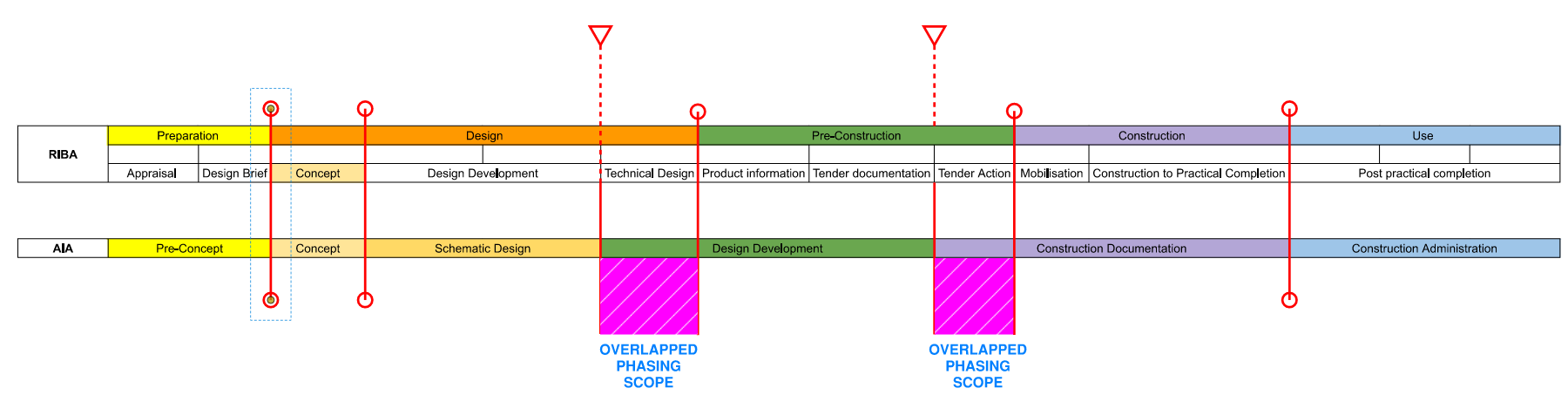
Note: Based on a total project timeline of 22 to 36 weeks, the AIA Schematic Design (SD) phase typically spans 4–8 weeks, while Design Development (DD) spans 8–12 weeks. When cross-referencing these with RIBA-derived standards, we find that approximately 12–15% of the technical requirements usually reserved for the DD phase must be front-loaded into the SD phase to satisfy regional 'Technical Design' expectations.
The Crisis Point:The Irreversible Ripple Effect
By the time a US firm reaches the end of SD, the regional client expects the depth of coordination found in RIBA Stage 3. Essentially, a regional "SD" is actually 50% of a US Design Development (DD) phase.
The Financial Deadlock (Fee Erosion): This misalignment is Contractually Invisible at the start. The US firm prices their "SD" based on AIA labor hours, yet is forced to perform "Shadow DD" work to satisfy regional technical gates. By the time the actual DD phase starts, the profit margin is gone.
The Responsibility Matrix Collapse: When phases are staggered, the RACI (Responsible, Accountable, Consulted, Informed) Matrix [4] becomes a liability. Because the regional timeline forces the Architect of Record (AOR) to make structural decisions during the "AIA SD" phase, the legal lines of professional indemnity blur.
The Quality Ripple Effect: This is the "Hidden Tax" on the building’s lifecycle. Teams resort to Reactive Detailing, choosing the fastest technical path to pass a municipal permit rather than the optimal one. This creates a permanent deficit in energy performance and design integrity.
The "No-Turn-Back" Point: Once the project moves into the regional "DD" (RIBA Stage 3/4), the Contractual Concrete has been set. You cannot "re-sync" a project that is already in motion.
The Knowledge Leak
The Knowledge Leak (The Day One Trap)
Failure is initiated on Day One. The "SD" gate in MENA is not a conceptual milestone; it is a Technical Vacuum.
The Hidden Implementation Cost: Regardless of the contract, the regional standard forces high-level coordination, structural thicknesses, MEP riser integration, and Jurisdictional Friction, during the period budgeted for "Massing and Character."
The Sunk Cost: The team performs 150% of their contracted labor just to keep the project from stalling.
The "Add Service" Illusion: Once the milestone schedule is locked and the AOR is activated, "Additional Services" are rarely viable. You cannot renegotiate the fee for "doing your job," even if the definition of that job was misaligned from the start.
The Brute Force Fallacy:
Why Tech Cannot Fix a Broken Timeline.
Management often attempts to mitigate this bleed through Aggressive Allocation, increasing staff headcount or deploying "Tech-Savvy" BIM specialists. While these maneuvers improve deliverable quality, they are Tactical fixes for a Strategic failure.
The Resource Burn: More staff during an under-budgeted SD phase only accelerates the financial deficit.
The Tech-Savvy Mirage: A skilled BIM team can coordinate clashes with speed, but they cannot coordinate Intent. Without strategic governance, the BIM model becomes a highly efficient record of a compromised vision.
LOD Decay Mitigation [5]: Standard BIM coordination is a tool for efficiency, but it cannot fix phase misalignment. Efficiency in a flawed process only accelerates the friction.
While manual headcount increases often lead to diminishing returns, the emergence of specialized tools like Style2ai provides a digital "Alignment Layer." By leveraging AI to bridge the gap between conceptual intent and regional technical requirements, firms can maintain design sovereignty without succumbing to the fee erosion typical of the AIA-RIBA mismatch.
The Alignment Layer: A Change in Navigational Logic
The solution is not more horsepower; it is a change in the Navigational Logic. To protect the project, you don't need a faster BIM manager; you need a Technical Governor.
In 25 years and 120 high-complexity projects, the most successful partnerships are those that recognize the need for an Alignment Layer, a veteran oversight that ensures every line drawn in the SD phase is already "Bilingual," satisfying regional technical hunger while protecting the conceptual sovereignty of the design.
End-Notes & Citations
American Institute of Architects (AIA).AIA Document B101™ – 2017: Standard Form of Agreement Between Owner and Architect.
Royal Institute of British Architects (RIBA).RIBA Plan of Work 2020 Overview. (Defines the transition between Stage 2 Concept and Stage 3 Spatial Coordination).
BIMForum.Level of Development (LOD) Specification 2023. (Referencing the discrepancy between AIA G202™-2013 and regional LOD 300 expectations at early stages).
Project Management Institute (PMI).A Guide to the Project Management Body of Knowledge (PMBOK® Guide). (On RACI Matrix integrity in multi-jurisdictional projects).
Architecture Atelier Forensic Archive.Internal Case Study 109: The Cost of Phase Latency in MENA Infrastructure Projects (2024).