The Phantom Phase: Why Global Mega-Projects Require an "Admiral" Strategy, Not a Spreadsheet

The international mega-project is the crown jewel of any ambitious US architecture firm. The scale is intoxicating, the design prestige is unparalleled, and the fees look monumental on paper. But seasoned practitioners who bridge the West and the Middle East know that the true test of a project's profitability doesn't happen during active design—it happens during The Phantom Phase.
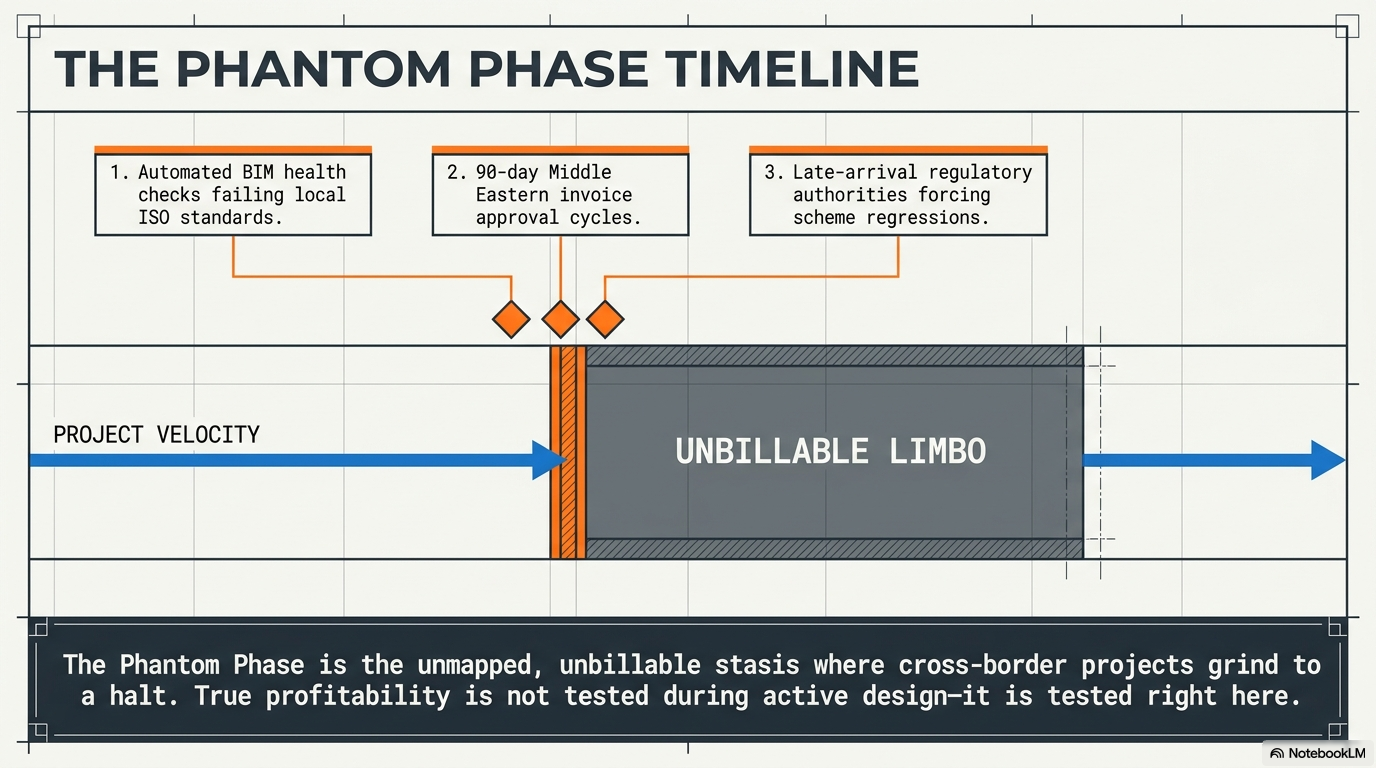
The Phantom Phase is that unmapped, unbillable limbo where an international project grinds to a halt—whether due to an automated BIM model health check failing local ISO standards, a 90-day Middle Eastern invoice approval cycle, or a late-arrival regulatory authority forcing a scheme regression.
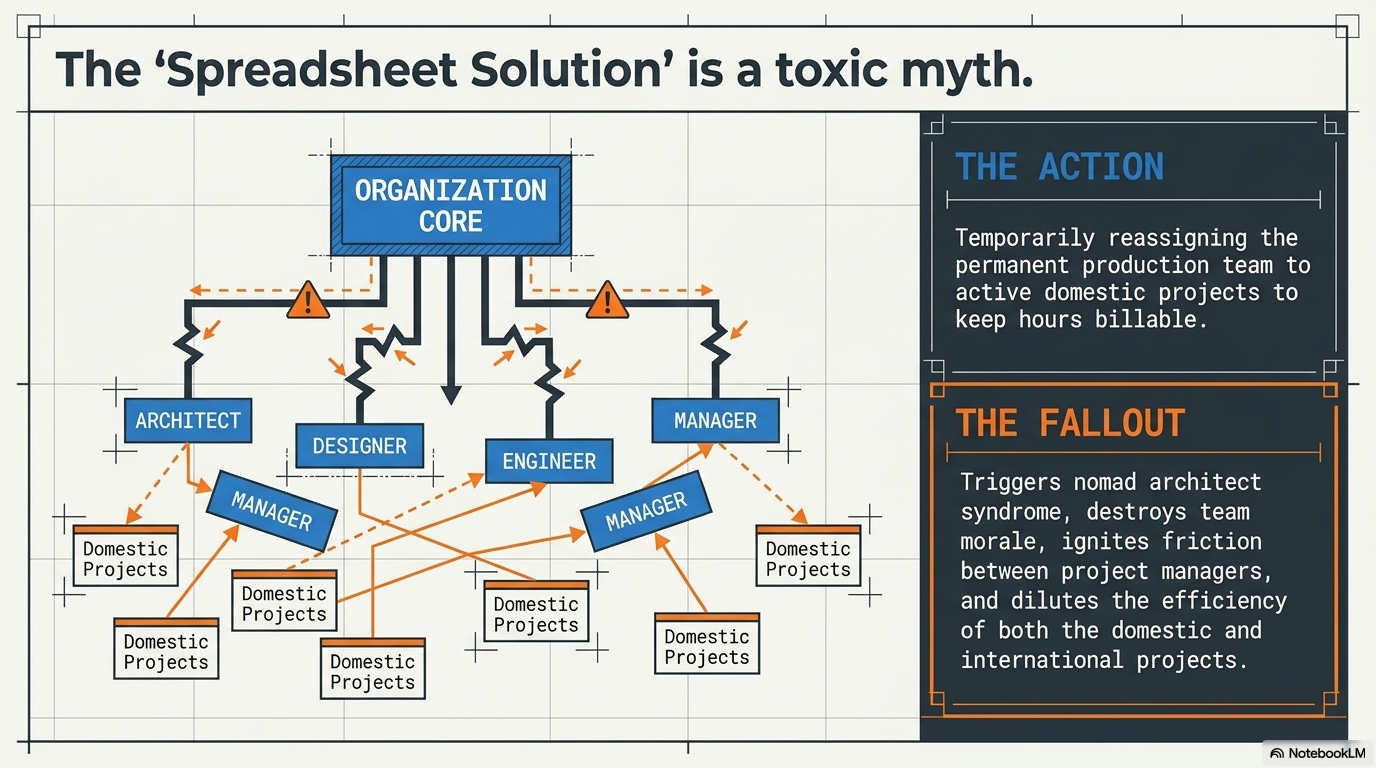
When these pauses hit, standard management textbooks offer a clean, corporate solution: Temporarily reassign your production team to active domestic projects to keep their hours billable.
But let’s be entirely honest: on the studio floor, this "spreadsheet solution" is a toxic myth. It creates a "nomad architect" syndrome, destroys team morale, causes friction between project managers, and dilutes the efficiency of both projects.
To survive cross-border developments, the solution cannot be reactive. It must be engineered on Day One of the project, completely restructuring how we budget, staff, and anticipate volatility.
Mitigating the Phantom Phase: The Lean Core & Shock-Absorption Strategy
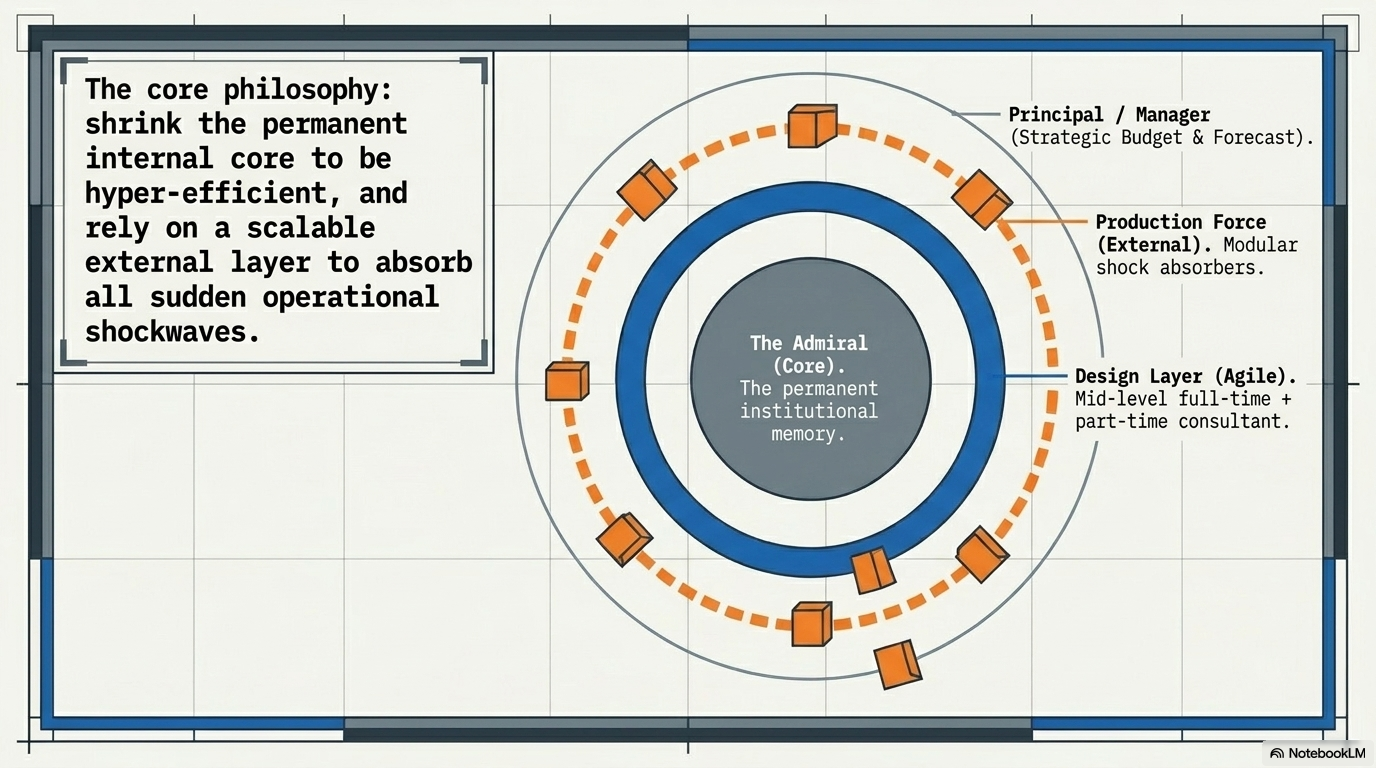
To survive cross-border developments, our response to project volatility cannot be reactive. It requires completely restructuring how we budget, staff, and anticipate downtime from Day One. The most effective solution for mitigating the financial bleeding of the Phantom Phase is a non-linear, tiered staffing model designed explicitly to absorb sudden operational shockwaves.
Instead of maintaining a massive, permanent full-time team whose unbillable hours will rapidly deplete your phase budget during a freeze, firms must aggressively optimize their internal roster. The ultimate goal is to shrink your core team of permanent employees to be as lean and hyper-efficient as possible, relying on a highly scalable external layer to handle high-volume production.
1. The Indispensable Core Team
The permanent internal team must be kept to an absolute minimum, anchored by highly specialized, strategic talent:
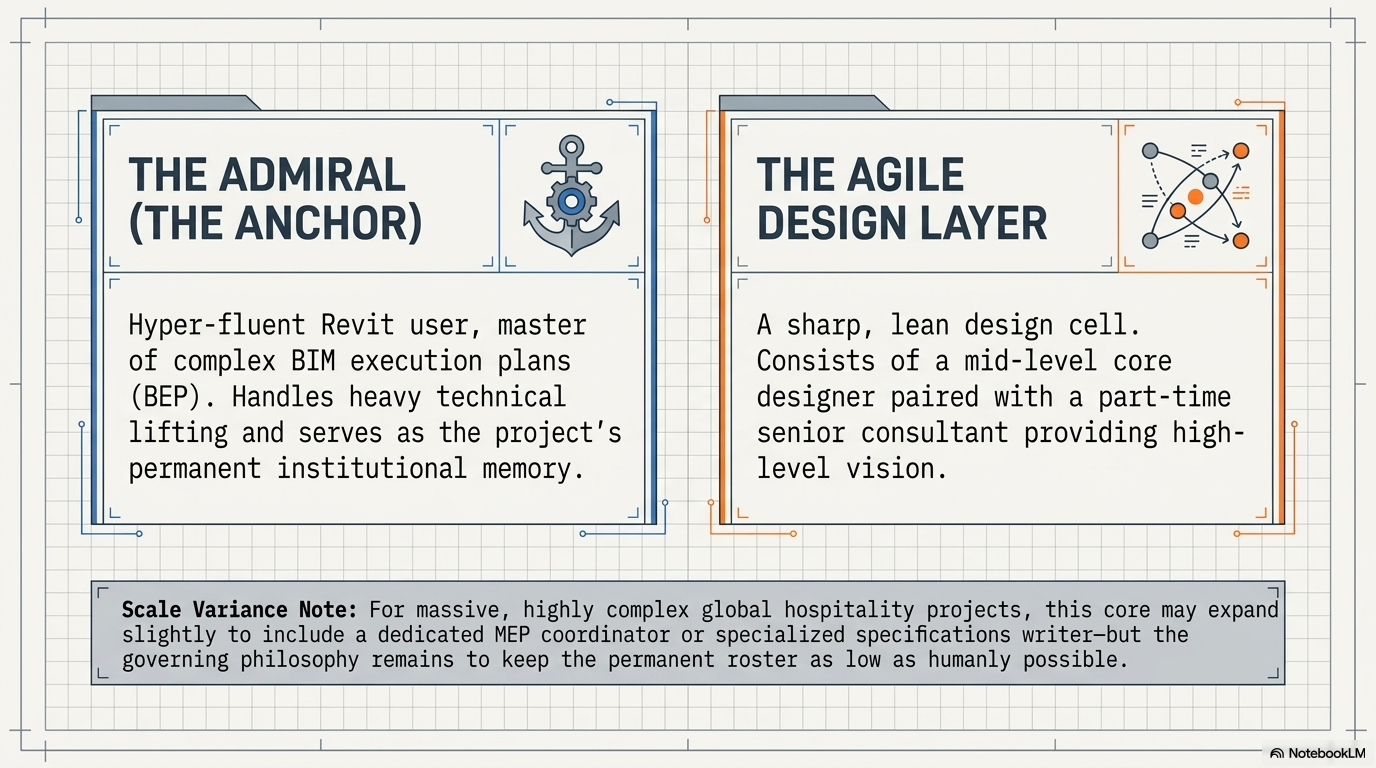
The Admiral: A hyper-fluent Revit user and master of complex BIM execution plans (BEP) who handles the heavy technical lifting and serves as the project's permanent institutional memory.
The Agile Design Layer: A lean design cell consisting of a sharp, mid-level core designer and a part-time senior consultant providing high-level vision.
A Note on Scale and Complexity
While the baseline strategy relies on this ultra-lean pairing, the core team is not rigid. Depending on the sheer size, intricate programming, and unique complexity of a global hospitality mega-project, this permanent team core can be slightly bigger. You may need to add a dedicated MEP coordinator or a specialized specifications writer to the permanent roster. However, the underlying governing philosophy remains identical: keep the permanent internal core as low and as efficient as humanly possible.
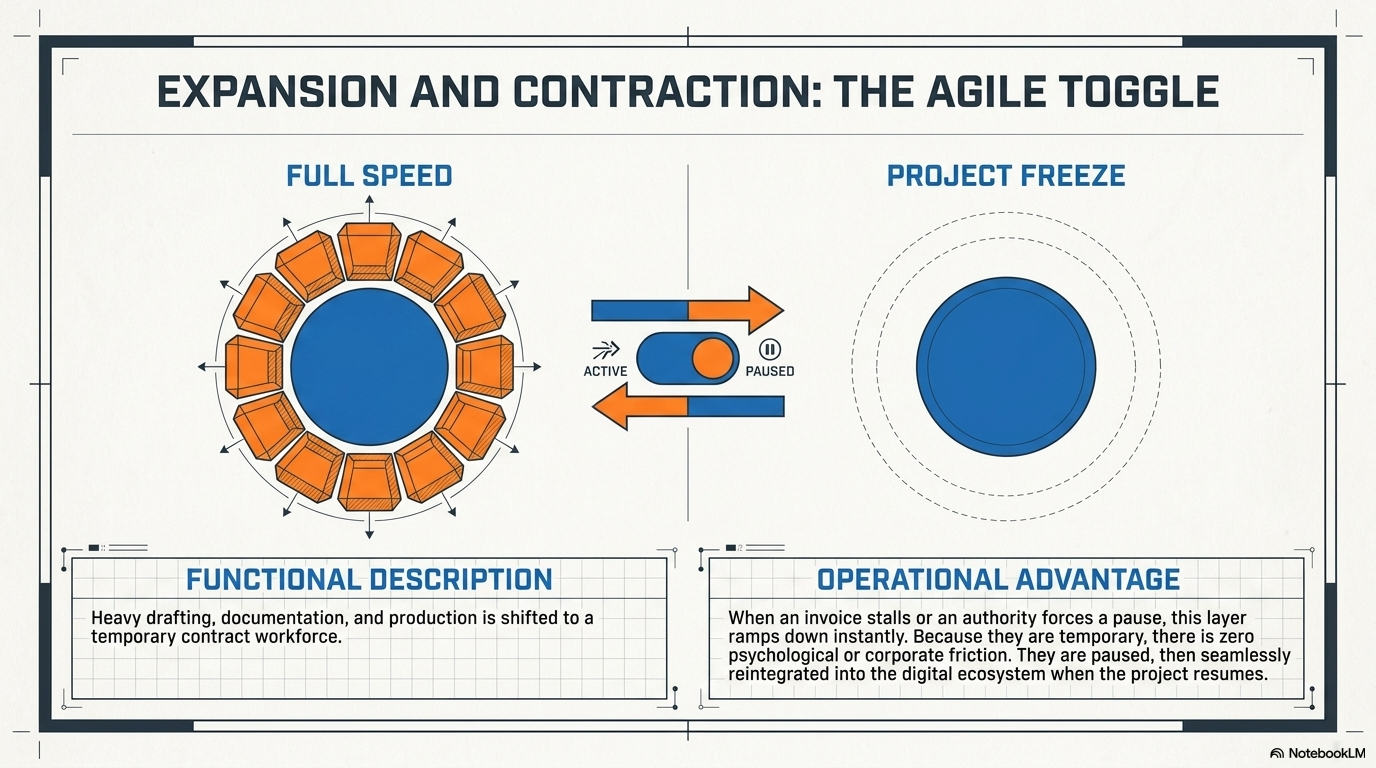
2. The Shock Absorbers: External On-Demand Production
The rest of the heavy drafting, documentation, and production workload is explicitly shifted to a temporary contract workforce. When the project operates at full speed, this external force handles high-volume output. The moment an invoice stalls or a local authority forces a pause, this entire layer is ramped down instantly. Because they are temporary staff, they do not suffer the psychological or corporate friction of internal reassignment; they are simply paused and seamlessly integrated back into the digital ecosystem when the project resumes.
Admittedly, vetting and selecting the right temporary staff—contractors who can immediately sync with your firm's standards, design philosophy, and complex BIM protocols without missing a beat—is an incredibly complicated process. It requires a distinct operational strategy, which we will break down thoroughly in a separate, upcoming article.
By separating your project workforce into a permanent, highly efficient core and an agile, external shock-absorption team on Day One, you insulate your firm from financial vulnerability. You ensure that when the Phantom Phase strikes, your burn-rate drops to a sustainable hum, keeping your project viable and your permanent talent secure.
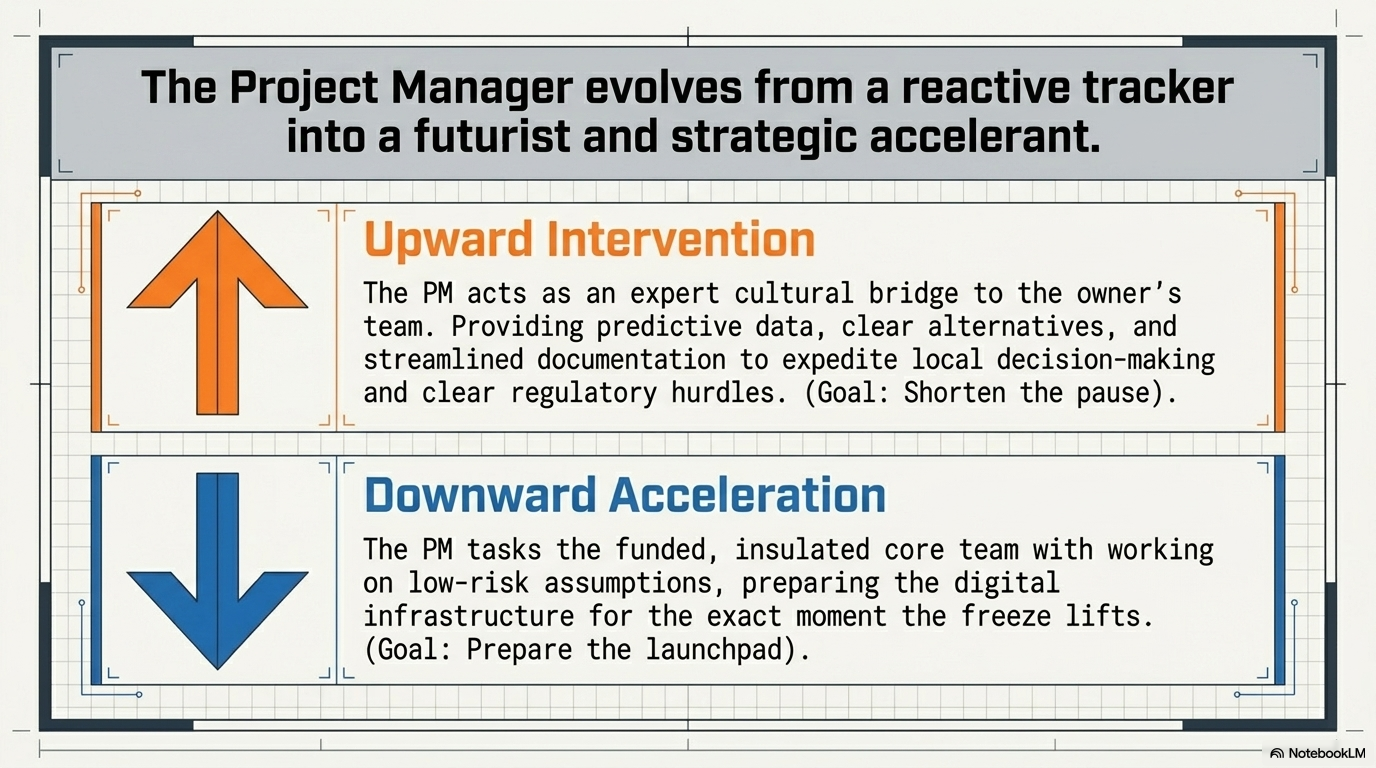
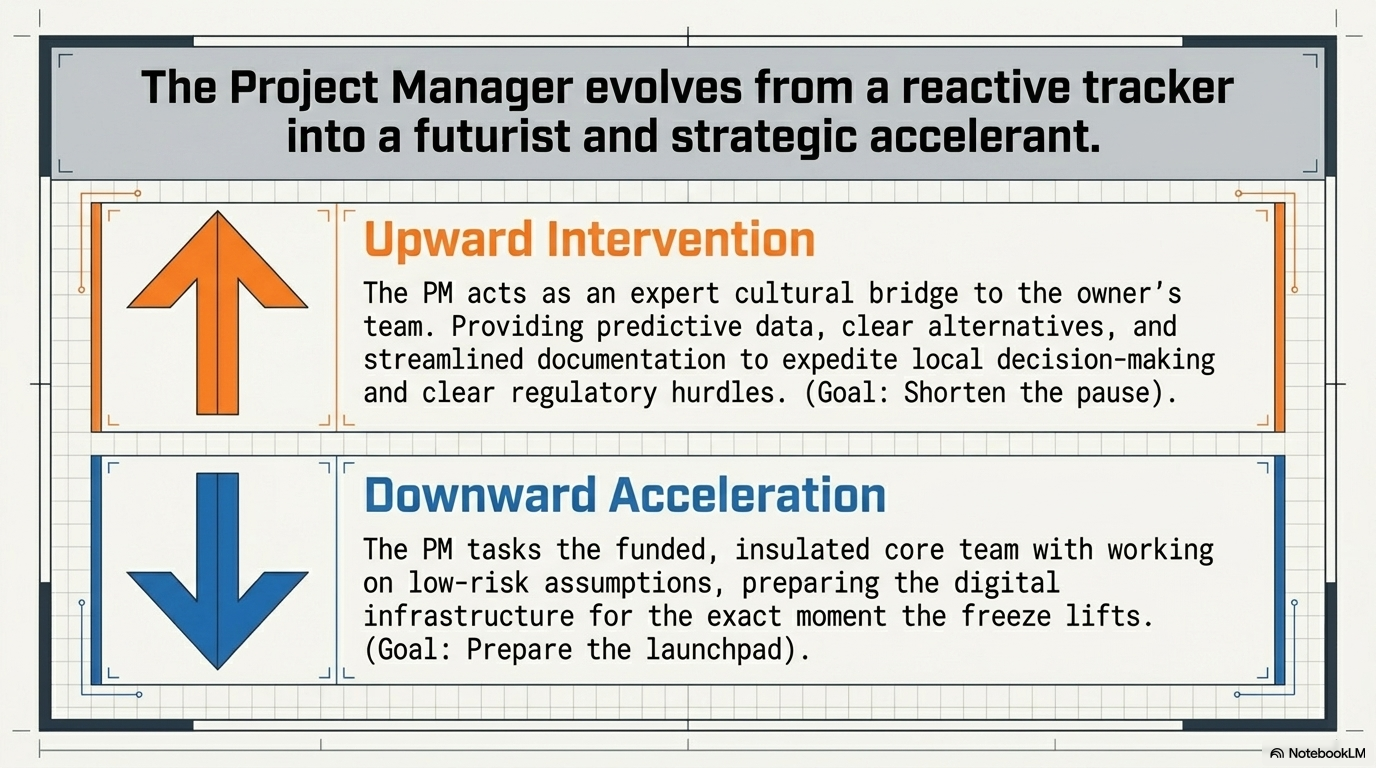
The New Angle: The Project Manager as a Futurist and Strategic Accelerant
By abandoning reactive linear staffing, the Project Manager's role changes entirely during a project freeze. Instead of panicking over unbillable hours, a forward-thinking manager treats the pause not as a liability, but as a high-velocity window to engineer competitive advantages and recover lost budget margins.
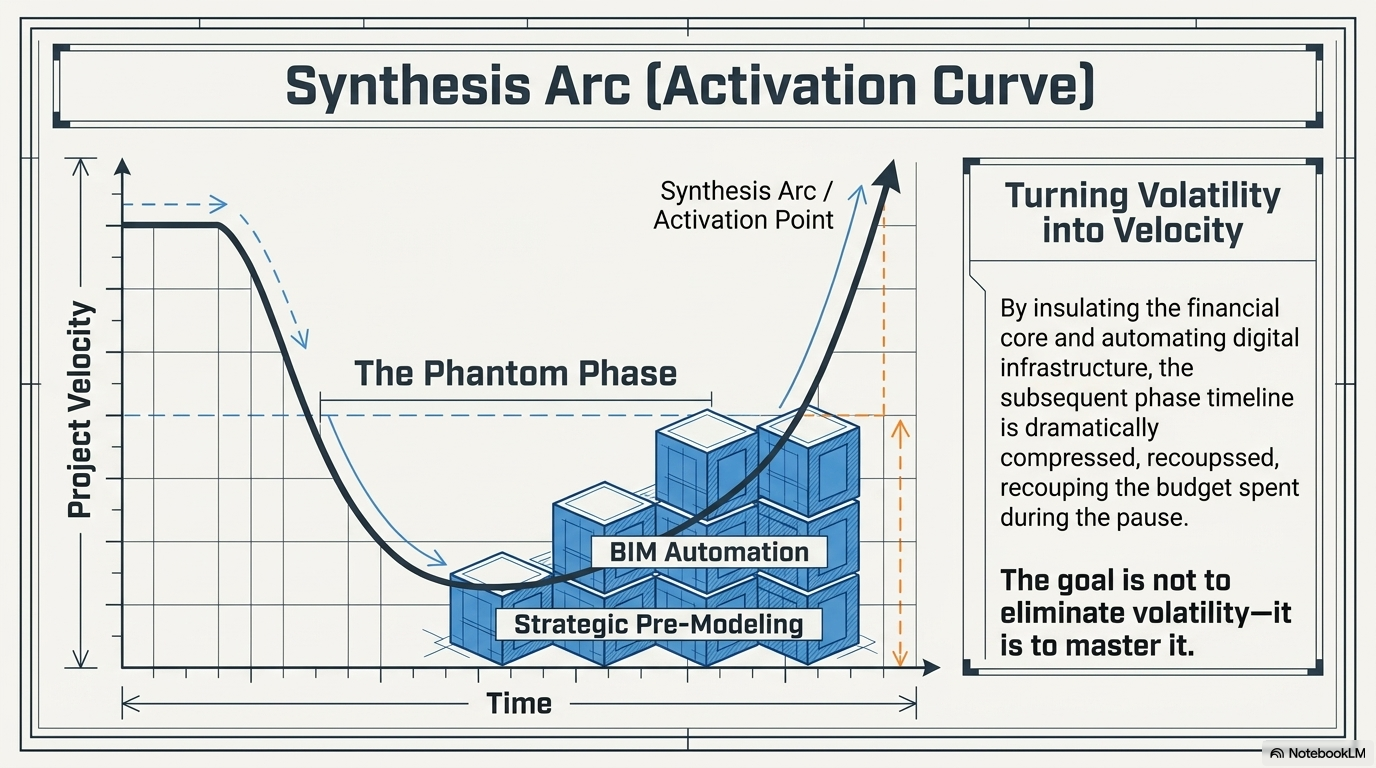
While the client sorts out financing or regulatory approvals, the internal core—the Admiral and the design team—remain explicitly funded because their cost was integrated into the long-term phase budget on Day One. Rather than entering a state of stagnation, the manager tasks them with working on low-risk assumptions of upcoming tasks, systematically preparing the digital infrastructure for the exact moment the freeze lifts.
During this strategic window, the core team focuses heavily on:
BIM Automation and Scripting: Developing and executing automated routines for repeated tasks, establishing clean templates, generating standard views, structuring blank sheet sets, and setting up future presentation assets.
Pre-emptive Interdisciplinary Coordination: Conducting advanced code research to map out potential conflicts between structural, MEP, and architectural systems before they happen on the live model.
AI-Driven Explorations: Leveraging AI-powered platforms to run instantaneous code analysis, perform complex material board studies, and rapidly research international manufacturers for specialized hospitality components.
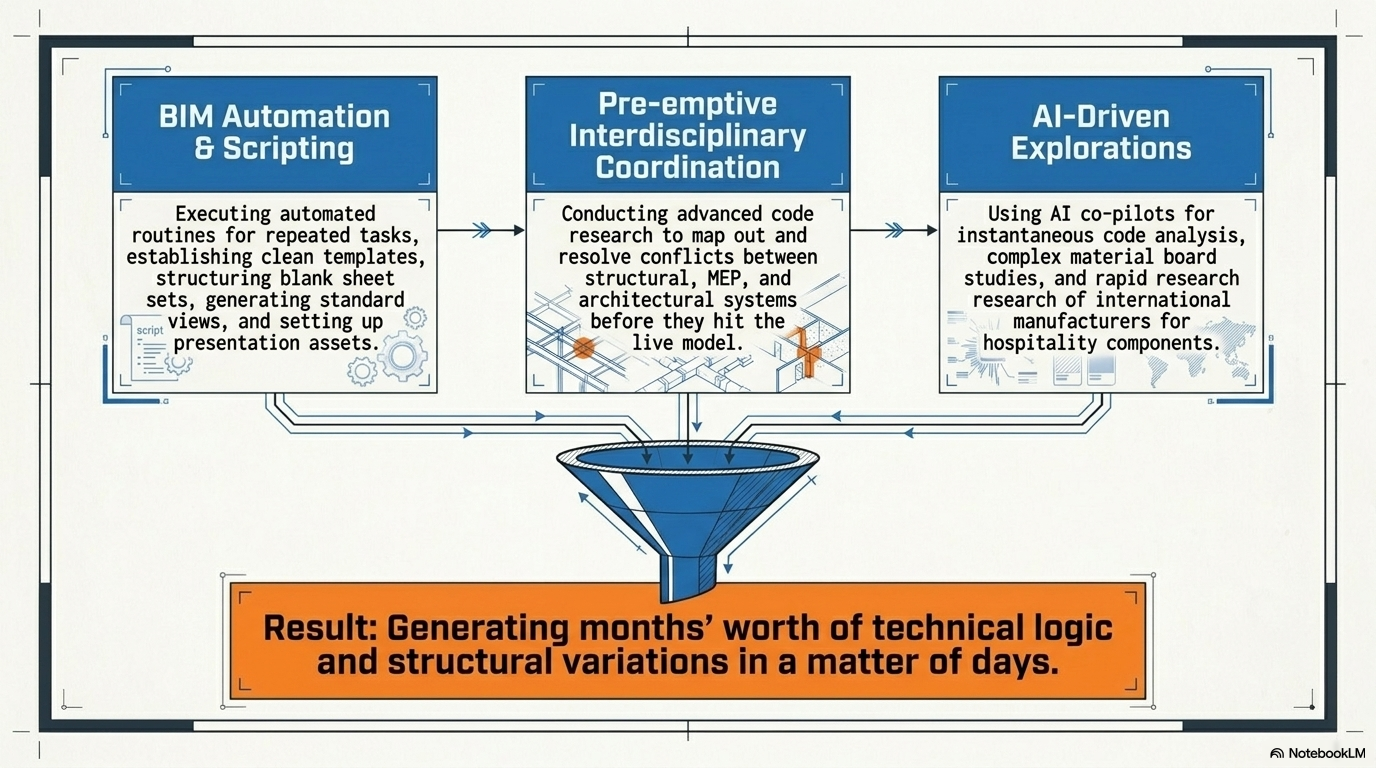
By utilizing an AI-driven digital co-pilot during downtime, a lean core team can generate months’ worth of technical logic, structural variations, and highly detailed design options in a matter of days. When the project rolls again, this massive head-start dramatically compresses the timeline of the subsequent phase. This hyper-acceleration allows the team to easily absorb the initial delay and directly recoup a significant portion of the budget spent during the pause.
Maintaining Absolute Project Focus
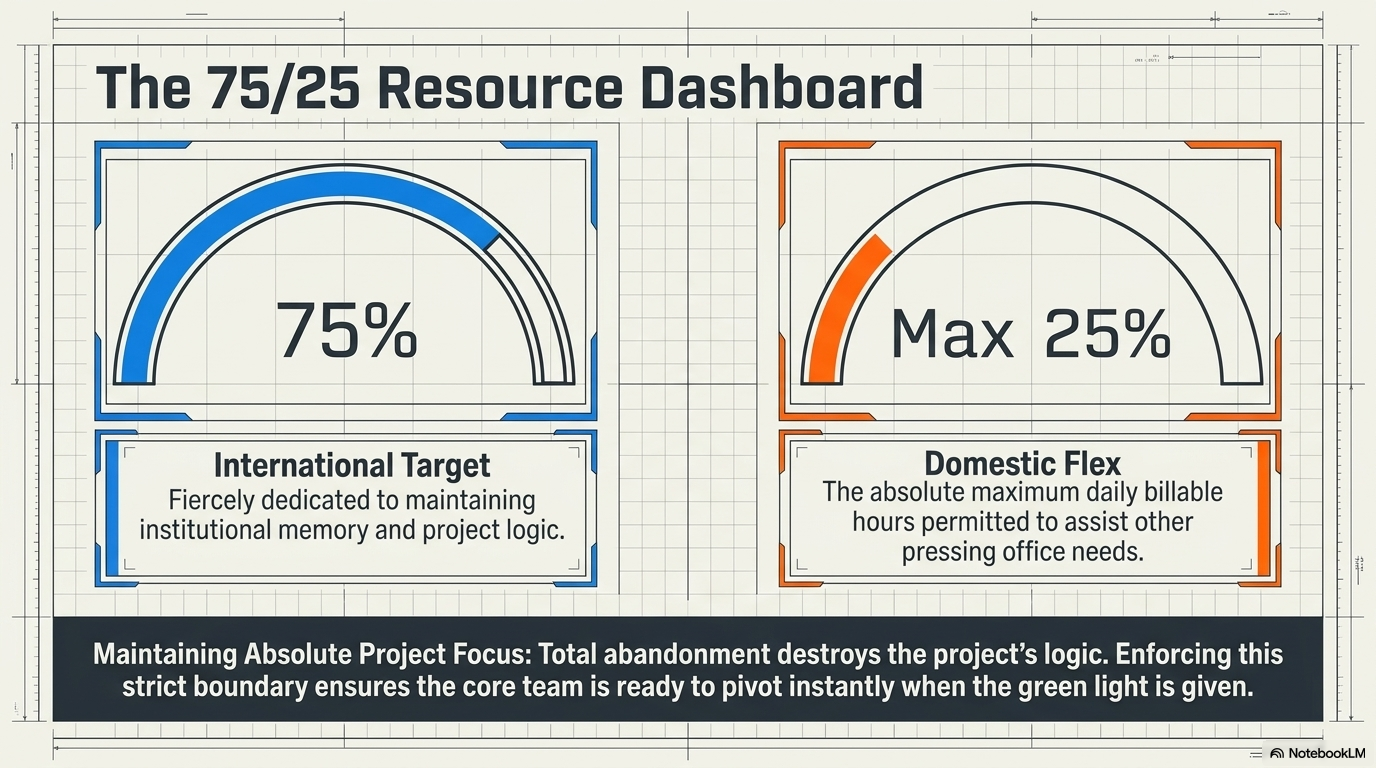
It is inevitable that during protracted, long-term pauses, firm leadership will look to borrow this core talent for other pressing office needs. While sharing knowledge is valuable, the Project Manager must enforce a strict boundary: the core team may dedicate a maximum of 25% of their daily billable hours to assisting other domestic projects. The remaining 75% must remain fiercely dedicated to primary international development. Total abandonment of the project destroys institutional memory; the core must stay deeply embedded in the project's logic so they are ready to pivot instantly when the green light is given.
The Project Manager's Real-Time Offensive
Simultaneously, the Project Manager does not simply wait passively for things to change. During the freeze, the manager steps into an offensive role, actively and strategically working to shorten the pause period. By serving as an expert cultural and operational bridge, the manager directly assists the owner’s team—providing them with predictive data, clear alternatives, and streamlined documentation to expedite local decision-making and clear regulatory hurdles.
When the pause finally ends, the project doesn't slowly crawl back to life—it hits the ground sprinting. The external production staff re-enters a hyper-organized digital ecosystem hosted on platforms where every upcoming task has already been mapped out, automated, and pre-vetted by a core team that never took their eyes off the prize.
Conclusion: Turning Volatility into Velocity
Navigating the high-stakes world of global hospitality mega-projects requires moving past the rigid staffing paradigms of domestic practice. The "Phantom Phase" is not an unforeseen disaster—it is an inevitability of cross-border development, born from differing cultural paces, shifting regulatory landscapes, and complex international procurement rhythms.
Firms that treat these pauses with reactive panic, scattering their talent across arbitrary domestic projects, will continue to bleed profitability and dissolve their institutional project memory. Conversely, visionary firms recognize that stability is engineered from inception. By maintaining an ultra-lean, highly focused core team, leveraging a hyper-scalable temporary production layer, and turning unbillable stasis into an AI-powered offensive, the modern architect transforms a project freeze into a competitive launchpad.
Ultimately, the goal is not to eliminate volatility—it is to master it. When you insulate your firm’s financial core, automate your digital infrastructure, and maintain a fierce 75% focus on your international target, your studio stops fearing the pause. You become an agile, cross-cultural bridge, ready to pivot instantly from strategic preparation to high-velocity execution the moment the green light flashes.
Coming Next: Part II of the Mega-Project Survival Guide
Managing the human matrix is only half the battle. To successfully execute this strategy, your digital infrastructure must be built to handle the strain of sudden stasis and hyper-speed restarts.
In our next article, "Architectural Infrastructure at Scale: Cross-Border BIM Automation and Success Case Studies," we will dive deep into the specific BIM execution protocols, data-sharing environments, and automated model compliance workflows required for international developments. We will also dissect a successful, real-world hospitality mega-project case study, showing exactly how these strategies were implemented to protect millions in design fees and compress delivery timelines.
## End Notes & Industry References
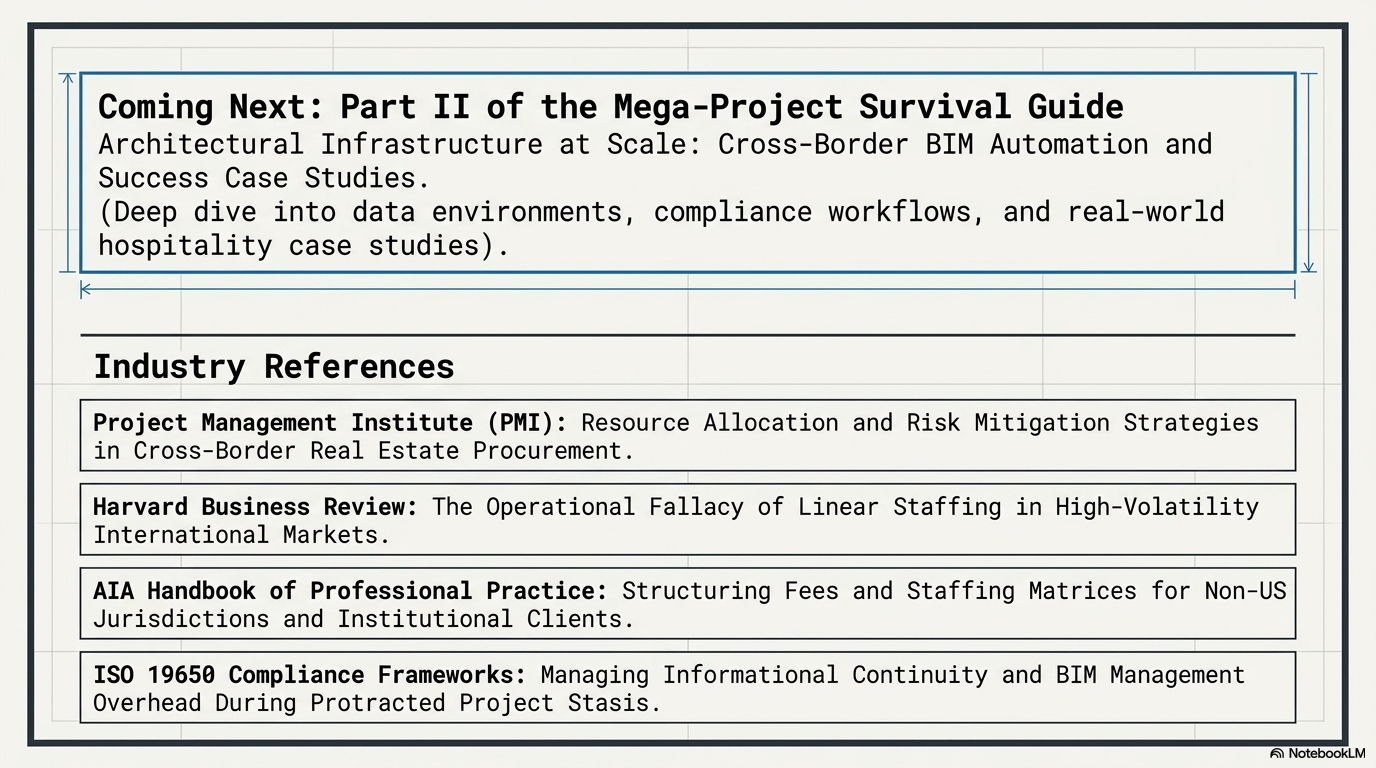
Project Management Institute (PMI):Resource Allocation and Risk Mitigation Strategies in Cross-Border Real Estate Procurement.
Harvard Business Review:The Operational Fallacy of Linear Staffing in High-Volatility International Markets.
AIA Handbook of Professional Practice:Structuring Fees and Staffing Matrices for Non-US Jurisdictions and Institutional Clients.
ISO 19650 Compliance Frameworks:Managing Informational Continuity and BIM Management Overhead During Protracted Project Stasis.